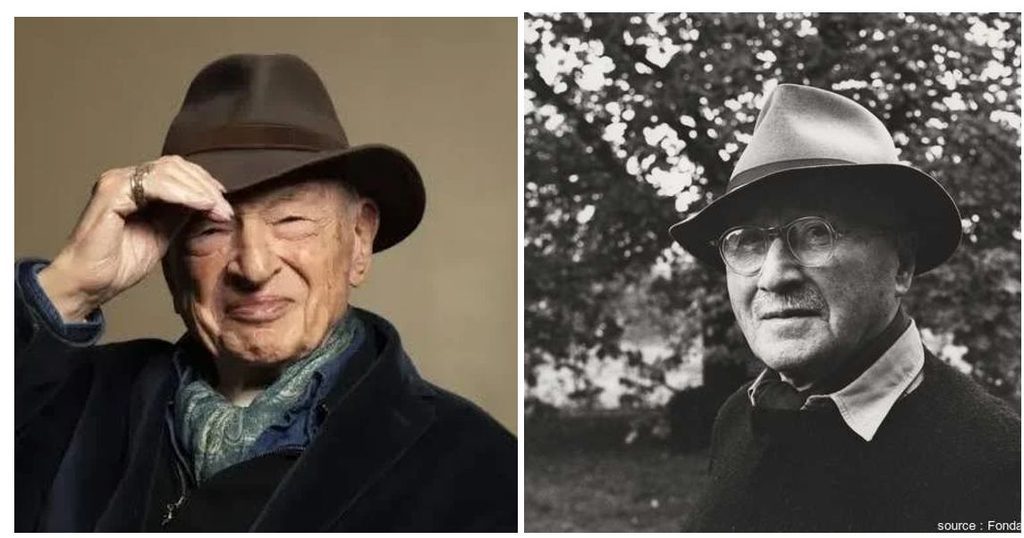
Following the passing of Edgar Morin on May 29, 2026, Jean-Marc Lieberherr paid tribute to the great European thinker in an original way: an imaginary posthumous dialogue between Edgar Morin and Jean Monnet.
Seated around a table, the two men discuss Europe, identity, peace, and the need to build solidarity. A dialogue between two Europeans who may have crossed paths during their lifetimes, and whose reflections still resonate with the challenges of today.
📢 Somewhere outside of time, two men, a table, two glasses…
MONNET – Welcome, Edgar. You see, all roads lead to “Paradis”—that’s the name we give to the Cognac cellars where we store our finest eaux-de-vie. Even if it took you a while to get here! Try this nectar…
MORIN — Thanks, Jean. I wasn’t in a hurry… I’ll leave the cognac to you; I’ll pair it with a red from Languedoc. I’m a man of the Mediterranean!
MONNET — I know exactly how you feel. My father was a cognac merchant. I left home at 16 to travel the world, but I always came back to Charente. In Cognac, we know how to wait. It’s the only way to make a good product. I’ve applied that lesson my whole life.
MORIN – And yet, we’ve both been called “cosmopolitan stateless people.” How ironic! The fact is, human identity is complex and doesn’t lend itself well to simplistic generalizations.
MONNET – I know a thing or two about that. Cognac has always been a constant in my life. I devoted myself to defending France during both world wars and to its reconstruction afterward. I realized that France without Europe would be nothing, and that Europe could make a vital contribution to the world.
MORIN – What you’re describing is essential, Jean. Identities don’t cancel each other out; they complement and enrich one another. You’re a man of action, but I wonder if you aren’t also a bit of a philosopher… But I’d go even further: while unity is lived, it is also conceived. Peoples need narratives, symbols, and an awareness of who they are.
MONNET – Do you think I have failed in this regard?
MORIN – Not at all. You did what you knew how to do. Creating de facto solidarity meant laying the material groundwork for the encounter. But I must admit that I have sometimes feared that Europe would become nothing more than a market, nothing more than a currency—a mechanism without self-awareness.
MONNET – You know, when you want to bring about change, you sometimes have to be ahead of your time. Europe is a peaceful revolution that is still in its infancy. But I understand your concern, and I share it. We must explain again and again why Europe is a necessity, why it is the only framework within which France can truly be itself. The alternative is decline.
MORIN – You’re speaking in economic terms again—that’s so typical of you, Jean. And even though you’ve been out of the business world for a long time, you’re addressing a very real concern today.
MONNET – I’m afraid so, unfortunately, and I’ve also heard that war is raging once again. Let’s save that for another time. For today, let’s finish our drinks—it’s often cold at the Panthéon, as you’ll see—a little something to warm us up won’t hurt.
MORIN – The Pantheon? At least give me a moment to get settled!